top of page

This study utilized a between-subjects experimental design to examine the effect of vibrotactile feedback on visual-manual workload and perceived usability during touchscreen-based IVIS interactions.
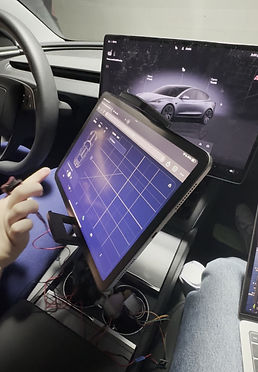
Participants were randomly assigned to either the experimental group, which received vibrotactile feedback during task interactions, or the control group, which did not. All sessions were conducted inside a stationary vehicle to best emulate an authentic vehicle setting and driving-relevant task scenarios.

To maintain experimental control, participants were instructed to keep their left hand on the steering wheel at all times and to interact with the iPad interface using only their right index finger.
During all tasks, behavioral metrics were recorded, and the session was video recorded, capturing the screen and the participant’s hands. Participants completed three standardized multi-step tasks representing essential driving functions.

Vehicle mock UI made using Figma and VSCode,
Target buttons for three tasks circled in blue

Participants wore a small fabric holder that secures the motor coin and wraps around the finger, allowing haptic feedback to be delivered directly to the finger when certain buttons are pressed.
A prototype external haptic motor was developed and used in this study to evaluate touchscreen interaction.

Immediately following task completion, participants completed the NASA Task Load Index (TLX).
The NASA-TLX is a widely used multidimensional self-report instrument assessing perceived workload across six subscales: mental demand, physical demand, temporal demand, performance, effort, and frustration.
The final portion of the study’s test session was a structured post-task interview. The interview explored three domains: user experience, attitudes toward touchscreen interaction while driving, and consumer preferences.


bottom of page